 Mukesh@gmail.com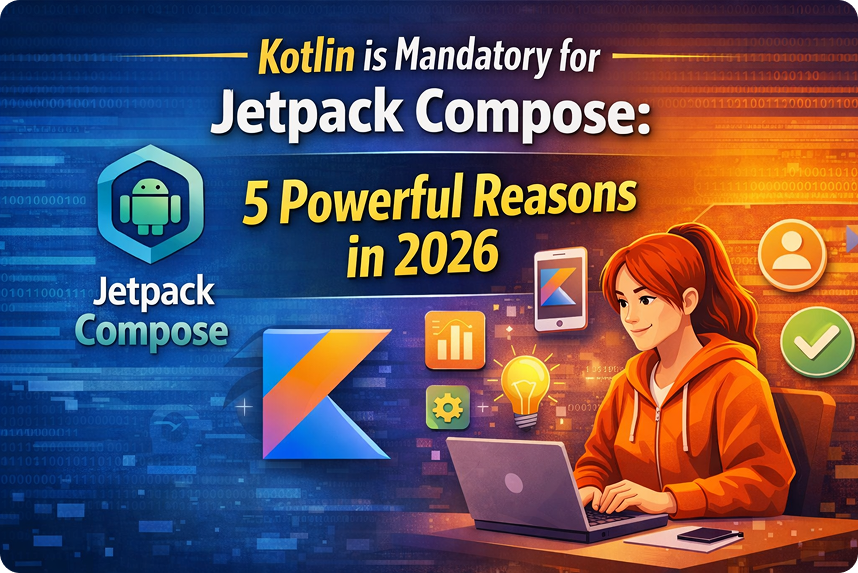
Introduction
If you’ve recently started exploring modern Android UI development, you’ve probably heard one thing repeated again and again — Jetpack Compose only works with Kotlin. Not Java. Not a mix. Just Kotlin.
At first, that might feel like a restriction. Especially if you’ve spent years writing Android apps in Java and everything works just fine. But the more you dig into how Jetpack Compose is built — the design decisions behind it, the language features it relies on — the more you realize this wasn’t an arbitrary choice. The reason Kotlin is mandatory for Jetpack Compose goes far deeper than just Google’s preference.
Jetpack Compose is fundamentally built on top of Kotlin’s most powerful language features. Without those features, the entire framework would either not work, or it would be so complex to write that nobody would actually use it. This article breaks down exactly why Kotlin is mandatory for Jetpack Compose in 2026, with five clear, practical reasons — explained in a way that makes sense even if you’re relatively new to Android development.
A Quick Look at What Jetpack Compose Actually Is
Before getting into the reasons, a little context helps. Jetpack Compose is Android’s modern UI toolkit. Instead of writing XML layouts — which is how traditional Android UI development worked — you write UI directly in code using composable functions.
A composable function looks something like this:
@Composable
fun Greeting(name: String) {
    Text(text = "Hello, $name!")
}
That’s it. No XML. No findViewById. No layout inflation. You describe what the UI should look like, and Compose takes care of rendering it.
The reason Kotlin is mandatory for Jetpack Compose becomes clear the moment you look at how these composable functions work internally. Every feature of Compose — from state management to animations to theming — relies on something Kotlin can do that Java simply cannot.
Reason 1: The @Composable Annotation Requires Kotlin’s Compiler Plugin
The very first building block of Jetpack Compose is the @Composable annotation. Every UI function you write gets marked with it. But this annotation doesn’t work the way normal Java annotations work.
In Java, annotations are mostly metadata — they attach information to code but don’t change how it executes. The @Composable annotation is completely different. It transforms the function at the compiler level through a custom Kotlin compiler plugin.
When the Kotlin compiler sees @Composable, it rewrites the function’s signature to include a hidden parameter called the Composer. This Composer is the core object Compose uses to track UI state, know which parts of the screen need to be redrawn, and manage the composition tree.
This kind of compiler-level transformation is only possible with Kotlin’s compiler plugin system. Java’s annotation processing works differently — it generates new code but cannot modify existing function signatures the way Kotlin’s compiler plugin does. That’s a fundamental technical reason why Kotlin is mandatory for Jetpack Compose at the most basic level.
Without this mechanism, Compose wouldn’t know when to recompose (re-draw) parts of your UI. The entire reactive UI model would fall apart.
Reason 2: Coroutines Power Every Animation and Async UI Operation
Anyone who has used Jetpack Compose for more than a few hours will encounter LaunchedEffect, rememberCoroutineScope, and animateFloatAsState. These are the tools you use for anything that involves time — waiting for data, running animations, responding to lifecycle events.
Every single one of these APIs is built on Kotlin coroutines. There’s no Java-compatible alternative. This is another major reason Kotlin is mandatory for Jetpack Compose — because coroutines are woven into Compose’s architecture at a structural level.
How Coroutines Connect to Compose
When you write this in Compose:
LaunchedEffect(key1 = userId) {
    val data = repository.fetchUser(userId)
    userState.value = data
}
The block inside LaunchedEffect runs in a coroutine that’s automatically tied to the composable’s lifecycle. When the composable leaves the screen, the coroutine is cancelled. When userId changes, the old coroutine is cancelled and a new one starts.
This behavior — automatically scoped, automatically cancelled, automatically restarted — is only possible because of how Kotlin’s structured concurrency works. Java threads don’t have this. Java’s CompletableFuture doesn’t have this. You can’t replicate this behavior cleanly in Java inside a Compose context.
This is a practical, everyday reason why Kotlin is mandatory for Jetpack Compose in 2026. If you try to imagine building a complex screen with animations and async data loading without coroutines, you’d end up with deeply nested callbacks and fragile lifecycle management.
Reason 3: Kotlin’s DSL Syntax Makes Compose Code Readable
One of the things that makes Jetpack Compose so pleasant to write is how naturally the code reads. Look at this example:
Column(
    modifier = Modifier.padding(16.dp),
    verticalArrangement = Arrangement.spacedBy(8.dp)
) {
    Text("Title")
    Text("Subtitle")
    Button(onClick = { /* action */ }) {
        Text("Click Me")
    }
}
This reads almost like a description of a layout. The indentation, the trailing lambda syntax, the way components nest inside each other — this is Kotlin’s DSL (Domain Specific Language) capability at work.
Kotlin allows functions to accept trailing lambdas, which lets you write Button { ... } instead of Button(content = { ... }). It also allows extension functions that let you chain Modifier properties like .padding().fillMaxWidth().background().
None of this works in Java. Java doesn’t support trailing lambdas in the same clean way. Java doesn’t have extension functions. You’d have to write verbose, ugly, deeply nested code that’s hard to read and even harder to maintain.
This DSL capability is a fundamental reason why Kotlin is mandatory for Jetpack Compose. The entire Compose API is designed around Kotlin’s lambda and extension function features. Strip those away and the API becomes practically unusable.
Reason 4: State Management in Compose Relies on Kotlin Delegates
State is the heart of any Compose UI. When data changes, the UI updates. Compose manages this through observable state objects — specifically through mutableStateOf, remember, and by delegation.
Here’s a typical Compose state declaration:
var count by remember { mutableStateOf(0) }
That by keyword is Kotlin’s property delegation system. When count changes, Compose automatically knows to recompose any function that reads count. This happens because MutableState implements Kotlin’s getValue and setValue operator functions, which are what property delegation requires.
Java has no equivalent to Kotlin’s property delegation. You could potentially write val count = remember { mutableStateOf(0) } and then access count.value everywhere, but the by shorthand — and the operator overloading that makes it work — is a Kotlin-only feature.
More importantly, the entire reactivity model in Compose depends on Kotlin’s type system and operator conventions. This is a deep structural reason why Kotlin is mandatory for Jetpack Compose. State management isn’t a thin layer on top — it’s built into how every composable function reads and responds to data.
If you’re looking for more on how Compose state works under the hood, the official Jetpack Compose state documentation is a solid starting point.
Reason 5: Kotlin’s Type System Enables Compose’s Safety Guarantees
Jetpack Compose makes certain guarantees that developers rely on — composable functions can be called multiple times (recomposition), they can be called in any order, and they can be skipped if inputs haven’t changed. These guarantees require the language to enforce certain rules at compile time.
Kotlin’s type system, combined with the Compose compiler plugin, enforces these rules. The compiler can detect when a function has side effects that break Compose’s assumptions. It can warn you when you’re calling a composable function from a non-composable context. It understands nullability, sealed classes, and exhaustive when expressions in ways that make Compose state handling safer.
Java’s type system isn’t strong enough to support this. Java lacks the null safety, the sealed class exhaustiveness checking, and the compiler extensibility that Compose’s safety model requires.
This is why Kotlin is mandatory for Jetpack Compose not just as a practical matter, but as a correctness matter. Kotlin’s type system is part of what makes Compose apps reliable, not just writable.
For more on how Kotlin’s type system benefits Android development broadly, the Kotlin language reference covers the underlying concepts well.
What This Means If You’re Still on Java
If your current Android app is written in Java and you’re thinking about adopting Jetpack Compose, the path forward is clear — you’ll need to add Kotlin to your project. The good news is that Java and Kotlin coexist well in the same project. You don’t need to migrate everything at once.
You can start by adding a single Kotlin file, writing your first composable function, and embedding it into an existing Java Activity using ComposeView. That’s a realistic first step that doesn’t require rewriting anything.
The reason Kotlin is mandatory for Jetpack Compose isn’t a gate meant to keep Java developers out — it’s a reflection of how deeply the framework is built on top of language features that only Kotlin provides in the JVM world.
How These 5 Reasons Connect to Each Other
It’s worth stepping back and noticing that these five reasons aren’t independent. They reinforce each other.
The compiler plugin (Reason 1) enables smart recomposition. Coroutines (Reason 2) power lifecycle-aware async operations. DSL syntax (Reason 3) makes the resulting code actually readable. Property delegation (Reason 4) makes state elegant and reactive. And the type system (Reason 5) keeps all of it safe.
Together, they explain fully why Kotlin is mandatory for Jetpack Compose. Remove any one of these capabilities and a significant part of the Compose framework would stop working or become unworkable.
Final Conclusion
In 2026, the question of why Kotlin is mandatory for Jetpack Compose has a clear, technical answer — not a political or marketing one. Jetpack Compose was designed from the ground up to use Kotlin’s compiler plugin system, coroutines, DSL syntax, property delegation, and type safety. Each of these is a Kotlin-specific feature with no direct Java equivalent.
If you’re building Android apps today and want to use Compose — and at this point, most new Android UI development happens in Compose — learning Kotlin isn’t optional. It’s the foundation everything else stands on. The sooner you get comfortable with Kotlin, the more naturally Compose will click.
The good news is that Kotlin is genuinely a pleasure to write once you get past the initial learning curve. And the UI you’ll be able to build with Compose makes the investment very much worth it.