 Mukesh@gmail.com
Introduction
This is probably one of the most common questions I see from people just getting into Android development. You open YouTube, search for an Android tutorial, and half the videos say “start with Java” while the other half say “just learn Kotlin.” It’s genuinely confusing, and nobody seems to give a straight answer.
The Java vs Kotlin for beginners debate isn’t new, but in 2026 it feels more urgent. The Android ecosystem has shifted dramatically. Jetpack Compose is now the default UI toolkit. Most new learning resources are Kotlin-first. And yet, millions of Java-based Android apps are still running in production, and plenty of job listings still mention Java.
So what should a beginner actually do? Should you grind through Java fundamentals first, or skip straight to Kotlin? This guide gives you a real, experience-based answer — no fluff, no fence-sitting. By the end, you’ll have a clear picture of where Java vs Kotlin for beginners stands in 2026, and exactly which path makes sense for your situation.
Why This Question Even Exists
To understand the Java vs Kotlin for beginners debate properly, you need a little history. Java was the original language of Android. When Android launched in 2008, Java was the only option. Developers spent years building apps, libraries, and frameworks with it.
In 2017, Google announced official Kotlin support for Android. By 2019, Kotlin became the preferred language. Since then, all of Google’s sample code, documentation, and new APIs have been written in Kotlin first.
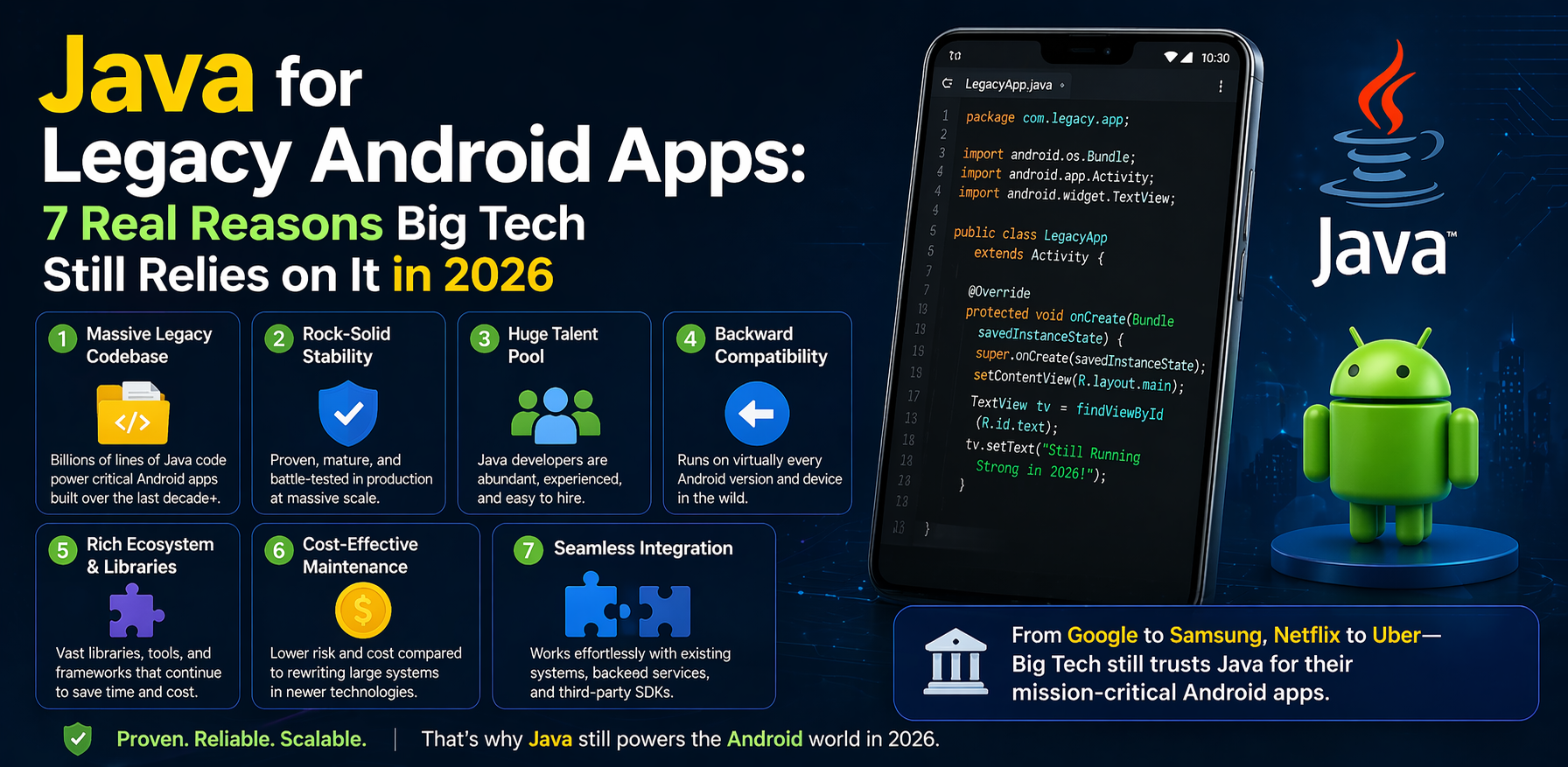
But Java didn’t disappear overnight. There are codebases with ten years of Java in them. There are university courses that still teach Java. There are textbooks that predate Kotlin entirely.
That history is why the Java vs Kotlin for beginners question keeps coming up. It’s not just about which language is technically better — it’s about where you’re learning from, what job you’re targeting, and how you want to spend the next 6–12 months of your learning time.
What Beginners Actually Struggle With in Each Language
Before giving a recommendation, it’s worth being honest about the real learning challenges in both languages. A lot of articles compare Java and Kotlin based on syntax alone. But for beginners, syntax is usually the smallest problem.
What Makes Java Harder for Beginners
Java is verbose. A lot of it. When you’re just starting out and you want to create a simple app that shows a list of items, you end up writing an Activity, an Adapter, a ViewHolder, an XML layout file, and a model class. That’s five files for something basic.
In the Java vs Kotlin for beginners context, this verbosity creates cognitive overload. Beginners spend so much time writing boilerplate — getters, setters, constructors, null checks — that they lose sight of what they were actually trying to build.
Also, Java’s null handling is brutal for beginners. NullPointerException is one of the most common crashes in Android apps, and Java gives you almost no help avoiding it at compile time. You have to learn defensive programming patterns early, which is a lot to ask of someone who’s still figuring out what an Activity is.
What Makes Kotlin Harder for Beginners
Kotlin has its own challenges. Some of its features — like extension functions, scope functions (let, apply, run, also, with), and coroutines — can look like magic when you first see them. Beginners sometimes copy-paste Kotlin code without understanding what it’s doing, which causes problems later.
In the Java vs Kotlin for beginners comparison, Kotlin’s conciseness is a double-edged sword. Code that experienced developers find elegant can be completely opaque to someone who doesn’t know what ?.let { } means yet. There’s less ceremony, but that means fewer clues about what’s happening under the hood.
That said, these are learnable challenges. They’re not dealbreakers. With decent resources, most beginners move past them within a few weeks.
The Case for Learning Java First
Some experienced developers still recommend Java as a starting point for beginners, and their reasoning isn’t wrong. Here’s the honest version of that argument.
Java Teaches OOP Fundamentals More Explicitly
Object-oriented programming concepts — classes, objects, inheritance, encapsulation, polymorphism — show up very explicitly in Java. Because Java is verbose, you see every moving part. When you create a class in Java, you manually write the constructor, the fields, the methods. Nothing is hidden.
In the Java vs Kotlin for beginners debate, this is Java’s strongest argument. Some developers feel that learning Java first gives beginners a solid mental model of how OOP works before Kotlin’s syntactic sugar starts hiding things.
Large Amounts of Legacy Code Are Still in Java
If you plan to work in a company that maintains older Android apps — and many companies do — you’ll encounter Java codebases. Knowing how to read and modify Java is a genuine professional skill.
From a Java vs Kotlin for beginners perspective, Java knowledge also helps you understand Stack Overflow answers and tutorials from before 2018, which are still widely referenced.
The Case for Learning Kotlin Directly in 2026
Here’s where I’ll be direct. In 2026, for most beginners, starting with Kotlin makes more sense. Here’s why.
All New Android Documentation Is Kotlin-First
Google’s official Android documentation, Jetpack library guides, Compose tutorials — everything is written in Kotlin. If you’re learning Java and trying to follow modern Android docs, you’ll constantly be mentally translating from Kotlin examples to Java equivalents. That’s extra cognitive work that slows you down.
In the Java vs Kotlin for beginners comparison, this is a practical problem that affects daily learning. The ecosystem has moved. Swimming against that current as a beginner doesn’t build character — it builds frustration.
Kotlin Is Genuinely Easier for Basic Tasks
A data class in Kotlin replaces 50 lines of Java boilerplate. String templates ("Hello, $name") replace verbose String.format() calls. Null safety is built into the language and catches mistakes at compile time rather than runtime.
For beginners writing their first apps, Kotlin lets you focus on Android concepts — Activities, ViewModels, navigation, state — rather than fighting Java ceremony. In the Java vs Kotlin for beginners debate, this matters a lot in the early months when motivation is fragile.
Jetpack Compose Cannot Be Used With Java
This is a hard fact that wasn’t true a few years ago but is very relevant now. Jetpack Compose — Android’s modern, standard UI framework in 2026 — is Kotlin-only. If you learn Java and want to build UIs the modern way, you’ll have to learn Kotlin anyway.
So in a very practical sense, Java vs Kotlin for beginners in 2026 is really asking: do you want to learn the tool you’ll actually use, or learn a different tool first and then switch?
What If You Already Know Some Java?
This is a different situation and worth addressing separately. If you’ve taken a Java course at university, done some Java in a bootcamp, or worked with Java in a non-Android context — you don’t need to “learn Java first.” You already have it.
In that case, the Java vs Kotlin for beginners question is really about transition. And the answer is: move to Kotlin now. You already understand OOP, you already know how classes and interfaces work, and Kotlin will feel like a cleaned-up version of what you already know.
The transition from Java to Kotlin is much easier than learning either language from scratch. Most developers who know Java well report that they feel productive in Kotlin within a few weeks.
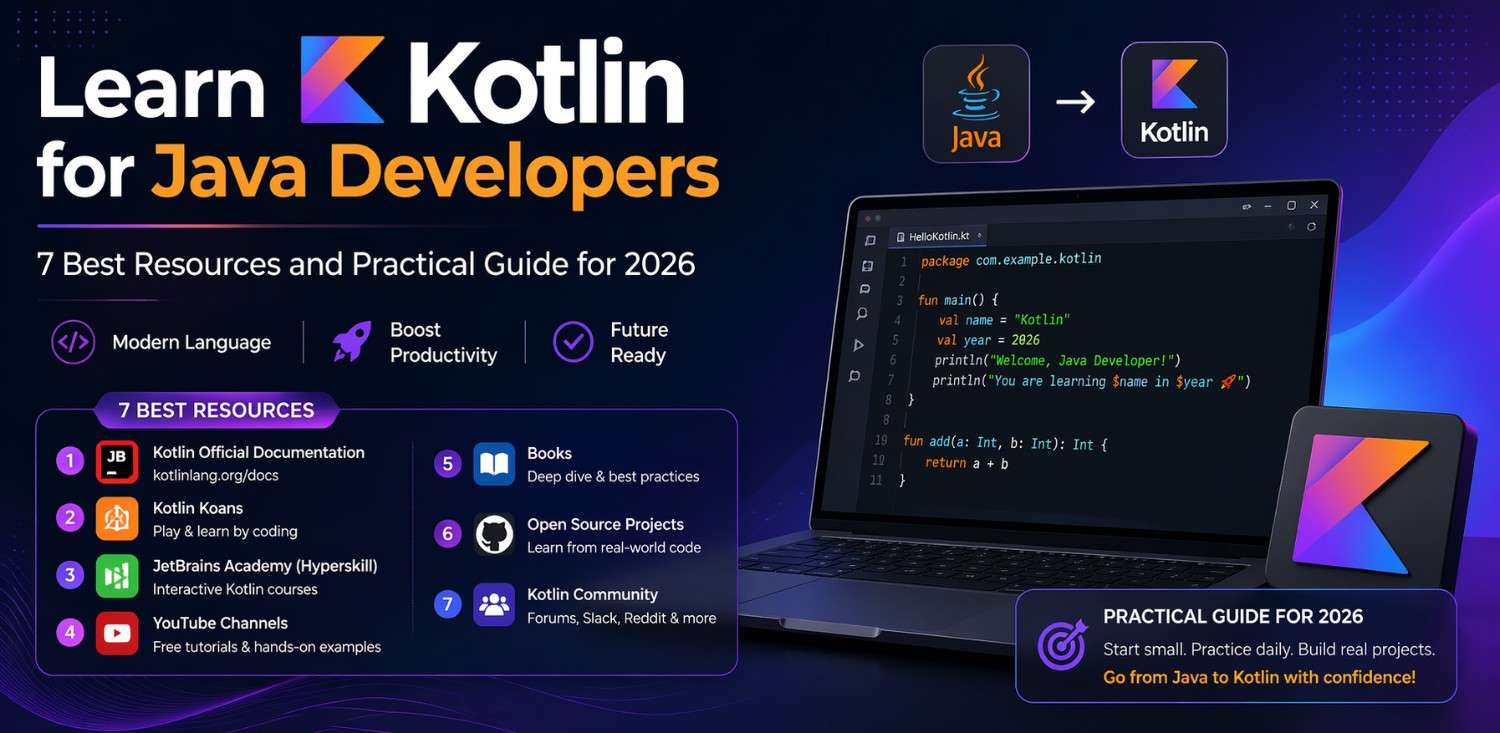
You can explore how Kotlin builds on Java knowledge through the official Kotlin for Java developers learning path, which is genuinely useful for this exact scenario.
A Realistic Learning Path for Beginners in 2026
Based on everything above, here’s what actually makes sense for someone starting Android development from scratch in 2026.
Step 1 — Learn Kotlin Basics First (Not Android Basics)
Spend two to three weeks just on Kotlin as a language. Variables, functions, classes, null safety, basic collections. Don’t touch Android yet. Use the official Kotlin learning resources at play.kotlinlang.org — they’re well-structured and beginner-friendly.
Step 2 — Learn Android Fundamentals With Kotlin
Once you’re comfortable with basic Kotlin syntax, start learning Android. Follow Google’s official Android basics course, which is Kotlin-based. Build small apps — a counter, a to-do list, a simple quiz.
Step 3 — Start Learning Jetpack Compose
After you understand Activities, ViewModels, and navigation, start exploring Compose. This is where the Java vs Kotlin for beginners investment really pays off — Compose only makes sense in Kotlin, and now you’ll be ready for it.
Step 4 — Read Java When You Encounter It
You’ll eventually need to read Java code — old Stack Overflow answers, legacy libraries, open-source projects. At that point, Java is easy to pick up passively because the concepts transfer directly from Kotlin.
Java vs Kotlin for Beginners: Side-by-Side Comparison
| Factor | Java | Kotlin |
|---|---|---|
| Verbosity | High | Low |
| Null Safety | Manual | Built-in |
| Modern Android Support | Partial | Full |
| Jetpack Compose | Not supported | Required |
| Job Market (legacy apps) | Relevant | Also relevant |
| Learning Resources (2026) | Older, less updated | Current, active |
| OOP Visibility | Very explicit | More abstracted |
Looking at this table honestly, the Java vs Kotlin for beginners comparison leans heavily toward Kotlin for anyone starting fresh in 2026.
Final Conclusion
The Java vs Kotlin for beginners question has a clearer answer in 2026 than it did even two years ago. If you’re starting from zero with no prior programming experience, learn Kotlin. The documentation is better, the syntax is cleaner, and every major modern Android framework — especially Jetpack Compose — is built for it.
If you already know Java from a previous context, skip the debate and start the transition. Your existing knowledge transfers directly and you’ll be writing Kotlin confidently faster than you expect.
Java isn’t dead and knowing it isn’t a waste. But for a beginner choosing where to spend their learning energy in 2026, Kotlin is the practical, future-facing choice. The Java vs Kotlin for beginners debate has been going on for years — but the Android ecosystem has been quietly voting for Kotlin, one API and one framework at a time.