 Mukesh@gmail.com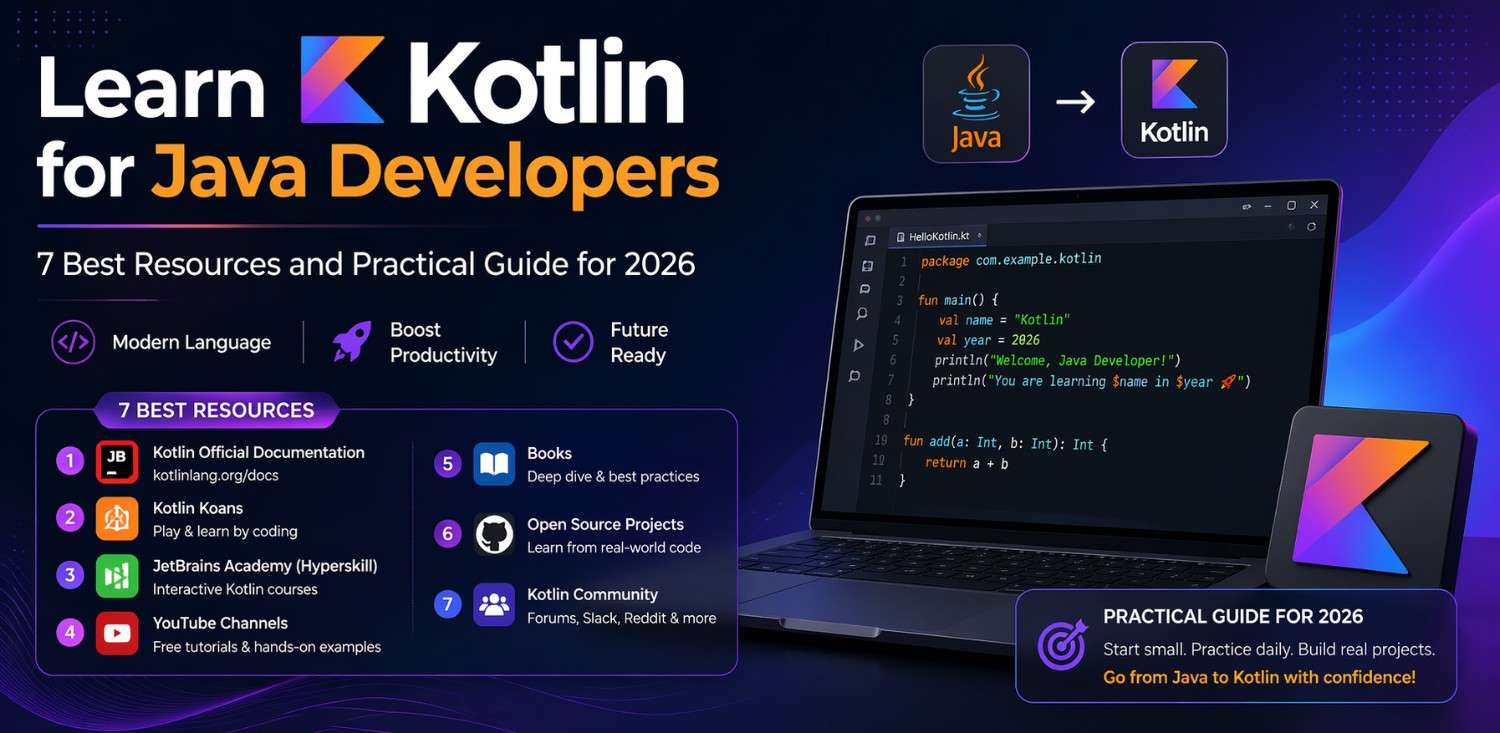
Introduction
If you already write Java and someone tells you to learn Kotlin for Java developers — don’t panic. This is not starting over. It’s more like upgrading to a better version of what you already know.
Java developers have a serious head start when they decide to learn Kotlin for Java developers because Kotlin runs on the same JVM, follows similar OOP principles, and integrates directly with existing Java code. You’re not throwing away years of experience. You’re building on top of them.
But here’s the real problem — most Kotlin tutorials online are built for complete beginners. They spend the first three hours explaining variables and loops. That’s not what you need. What you need are resources that respect your Java background and focus on what’s actually different.
This guide gives you exactly that. Seven practical, genuinely useful resources to learn Kotlin for Java developers in 2026 — with real advice on how to use them effectively.
Why Java Developers Should Learn Kotlin in 2026
Google officially recommends Kotlin as the primary language for Android development. Most new Android projects, open-source libraries, and Jetpack components are now written in Kotlin first. If you want to stay relevant in Android development, you need to learn Kotlin for Java developers sooner rather than later.
The good news? The transition is shorter than most people expect. Kotlin’s syntax is cleaner, more concise, and honestly more enjoyable to write once you get past the initial unfamiliarity.
What Changes and What Stays the Same
When you learn Kotlin for Java developers, the core programming concepts don’t change. Object-oriented design, collections, exception handling, generics — all of that carries over directly.
What changes is the syntax, the style, and some powerful new features. Null safety, data classes, extension functions, and coroutines are the big ones. These don’t exist in Java the same way, and they’ll take some genuine adjustment. But they’re also the features that make Kotlin worth learning in the first place.
Resource 1 – Official Kotlin Documentation (Free)
The single best starting point to learn Kotlin for Java developers is JetBrains’ official documentation. Most people skip this and go straight to YouTube, which is a mistake.
JetBrains has a dedicated “Java to Kotlin” guide that maps familiar Java patterns directly to their Kotlin equivalents. Java constructors, static methods, checked exceptions — it shows you exactly how each one translates. That direct comparison is incredibly efficient when you already think in Java.
The docs also include runnable browser-based code snippets. You can test Kotlin syntax as you read without setting up a project.
Start here: kotlinlang.org Java-to-Kotlin Guide. Read this before anything else — it’ll give you a map of the territory.
Resource 2 – Kotlin Koans (Free, Fastest Syntax Practice)
Kotlin Koans are probably the most efficient way to learn Kotlin for Java developers at a syntax level. They’re small, focused coding exercises where each challenge is a failing unit test. Your job is to write Kotlin code that makes it pass.
No long videos. No setup headaches. Just problem-solving in Kotlin, directly in the browser.
Working through all the Koans takes most developers two to five hours. But by the end, you’ll have real hands-on exposure to Kotlin’s most important features — lambdas, data classes, extension functions, collections, and more.
Find them at play.kotlinlang.org/koans. They’re completely free. Do all of them before moving on to bigger resources.
Resource 3 – Coursera’s “Kotlin for Java Developers” Course
This is the most directly named resource to learn Kotlin for Java developers — and it lives up to the title. The course was created by JetBrains themselves and is hosted on Coursera.
It assumes you already write Java. The instructors don’t waste time explaining OOP basics or what a variable is. Instead, they focus on Kotlin-specific features: null safety, functional programming patterns, coroutines, and Android integration.
You can audit the full course for free at Coursera, which means you get access to all videos without paying. Graded assignments and a certificate require a fee, but for most Java developers, the free audit gives you everything you need.
This course is especially useful if you prefer structured, video-based learning with a clear progression.
Resource 4 – JetBrains Academy (Paid, Most Structured)
JetBrains Academy is one of the most thorough platforms available to learn Kotlin for Java developers in a structured environment. It’s not free, but it’s purpose-built by the people who created Kotlin.
The platform connects directly to IntelliJ IDEA — which you probably already use as a Java developer. The learning experience feels natural because you’re coding in your actual development environment, not some stripped-down browser editor.
The exercises are practical and language-specific. Sealed classes, when expressions, higher-order functions, companion objects — all explained with exercises that reinforce the concept immediately after you read it.
If you’re serious about making Kotlin your primary language and want a structured curriculum to learn Kotlin for Java developers without piecing together random tutorials, JetBrains Academy is worth the investment.
Resource 5 “Kotlin in Action” Book
For Java developers who learn best through reading, Kotlin in Action by Dmitry Jemerov and Svetlana Isakova is the most comprehensive book available to learn Kotlin for Java developers at a conceptual level.
Both authors are JetBrains engineers who actually built parts of the language. That insider perspective makes a real difference. They explain not just what Kotlin does, but why certain decisions were made — which helps experienced Java developers understand Kotlin as a coherent design, not just a collection of new syntax.
The chapters on Kotlin’s type system, lambda expressions, and coroutines are especially valuable. These are the areas where Kotlin diverges most significantly from Java, and the book handles them clearly.
Plan for a few weeks of reading alongside real project work. It’s not a quick skim — but it’s the most thorough way to learn Kotlin for Java developers if you want genuine depth.
Resource 6 – Android Official Codelabs (Free, Hands-On)
Google’s Android Kotlin codelabs are the most practical free resource to learn Kotlin for Java developers specifically for Android development.
These are step-by-step coding exercises where you build real Android components — ViewModels, RecyclerViews, Navigation, and more — entirely in Kotlin. You’re not just reading about the language; you’re writing it in an actual Android project context.
That Android context matters a lot. A generic Kotlin tutorial won’t show you how coroutines integrate with LiveData, or how extension functions are used in Jetpack libraries. The codelabs do.
Find them at developer.android.com/codelabs. Start with the “Android Basics in Kotlin” series. Some of it will feel familiar — but the Kotlin-specific Android patterns are worth seeing in real project structure.
Resource 7 = Philipp Lackner on YouTube (Free, Android-Focused)
YouTube has a lot of Kotlin content, most of it average. Philipp Lackner’s channel is one of the few that’s consistently worth watching for someone trying to learn Kotlin for Java developers in an Android context.
He covers practical, real-world patterns — Clean Architecture, dependency injection with Hilt, Jetpack Compose, coroutines — all in Kotlin. What separates his content from most YouTube tutorials is that he explains why he’s writing code a certain way, not just what to type.
For Java developers who already understand Android fundamentals, his channel fills in the gap around Kotlin-specific Android patterns. Things you won’t find in a generic Kotlin course but will definitely encounter in a real Android job.
How to Actually Use These Resources Together
Having seven resources is useless if you don’t have a plan. Here’s a practical sequence to learn Kotlin for Java developers without getting overwhelmed.
Start with the official Java-to-Kotlin documentation — one focused reading session. Then complete all the Kotlin Koans for syntax practice. After that, pick one real feature or module from a Java project you’ve already built and rewrite it in Kotlin. Kotlin and Java are interoperable, so nothing breaks.
When you hit conceptual walls — and you will — go to Kotlin in Action or the Coursera course for deeper explanation. Use the Android codelabs and Philipp Lackner’s channel to stay grounded in real Android development patterns throughout.
This layered approach is how most experienced Java developers successfully learn Kotlin for Java developers without losing momentum.
Common Mistakes Java Developers Make When Learning Kotlin
Even with great resources, a few things consistently trip people up when they first learn Kotlin for Java developers.
Writing Java code in Kotlin files is the most common one. It compiles and runs, but you miss everything that makes Kotlin better. Force yourself to use data classes, named arguments, and extension functions from day one — even when the Java way feels faster.
Ignoring null safety is another. Java developers are used to null being a normal state. Kotlin treats null as explicit and deliberate. Embrace it — don’t try to suppress it with !! everywhere.
Skipping coroutines because they look complicated is a mistake too. Coroutines are how Kotlin handles async work on Android. They replace AsyncTask, RxJava in many cases, and callback chains. Learning them is essential, not optional.
Being aware of these pitfalls before you start helps you avoid them when you learn Kotlin for Java developers in practice.
Final Conclusion
The path to learn Kotlin for Java developers in 2026 is clearer than ever. The resources are mature, the community is large, and your Java background gives you a genuine advantage over complete beginners. You’re not starting over — you’re translating existing knowledge into a better tool.
Use the official docs and Koans to build your foundation. Deepen it with the Coursera course or Kotlin in Action. Keep it grounded in Android reality through the codelabs and YouTube. And most importantly, write real Kotlin code in real projects from day one — that’s where the actual learning happens.
The transition takes weeks, not months. And once Kotlin clicks, most Java developers find it genuinely hard to go back.