 Mukesh@gmail.com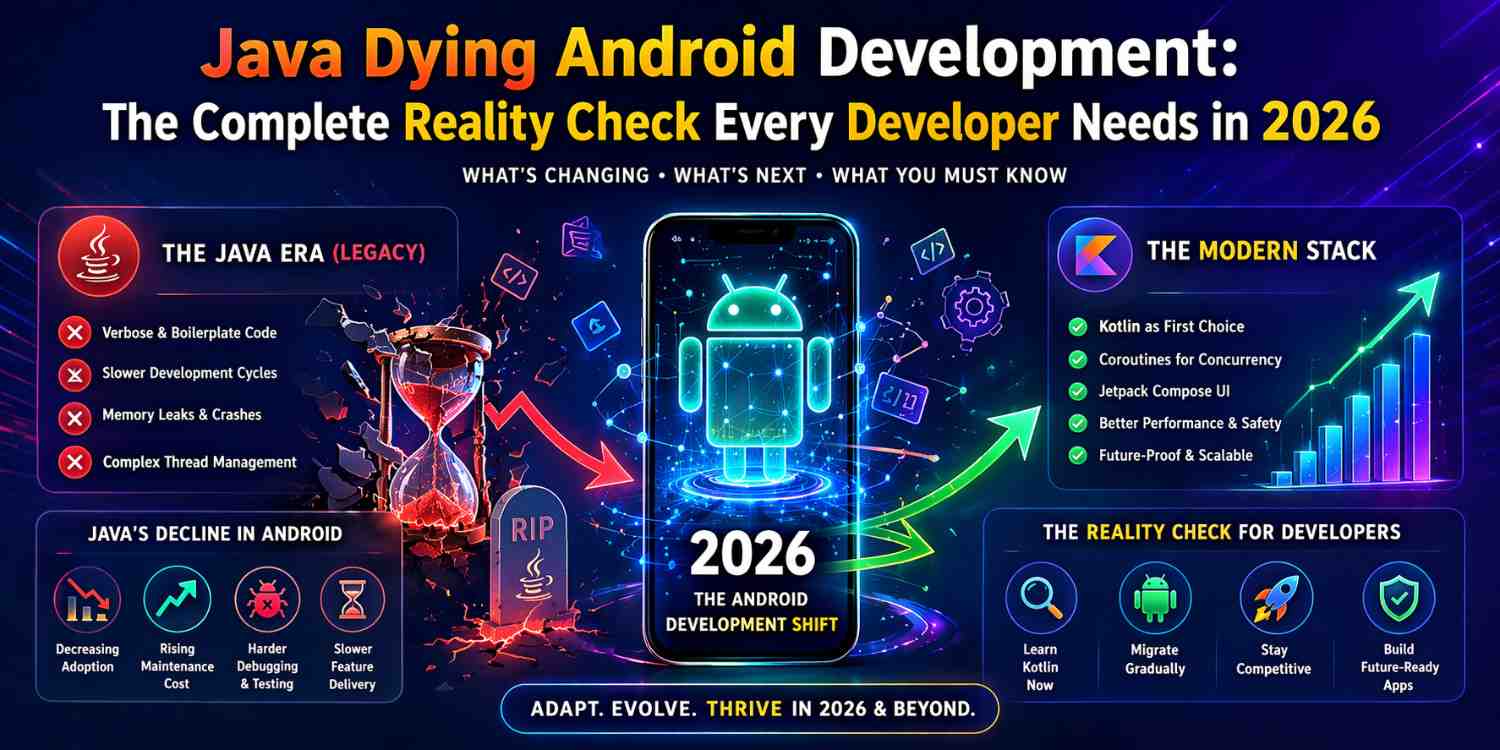
Introduction
If you’ve been part of the Android developer community for even a couple of years, you’ve probably heard someone say “Java is dying” in a meetup, a YouTube comment, or a Reddit thread. The debate gets loud sometimes. And honestly, when I first started building Android apps back when Android Studio was still relatively new, Java felt bulletproof — like it would never go anywhere.
But things have changed. Java dying Android development is not just a buzzword anymore. It’s a genuine shift that’s been unfolding slowly but clearly since Google made a big announcement back in 2019. If you’re a beginner trying to figure out which language to learn, or an intermediate developer wondering whether to migrate your codebase — this article is for you.
Let me walk you through the real picture. Not hype. Not marketing. Just what’s actually happening and what it means for your Android career in 2026.
What Does “Java Dying in Android” Actually Mean?
First, let’s be clear about what we’re really talking about when people say Java dying Android development.
It doesn’t mean Java stopped working overnight. Your old Java-based apps still run fine on Android phones. The Android runtime hasn’t dropped Java support. But the ecosystem — the tools, the community energy, the official documentation, the job postings — has visibly shifted.
Think of it like this: imagine a restaurant that used to serve a specific dish as their signature item. They still have it on the menu. But every new dish being added is something else entirely, all the marketing talks about the new direction, and the chef now specializes in something different. The old dish isn’t gone. It’s just… deprioritized.
That’s Java in Android development right now.
How Kotlin Changed Everything for Android
In 2017, Google announced Kotlin as an officially supported language for Android. By 2019, they went further and declared Kotlin as the preferred language for Android development. This was huge.
Kotlin isn’t some experimental technology. It runs on the same JVM that Java uses. It compiles to the same bytecode. You can mix Kotlin and Java in the same Android project — and many teams do exactly that during gradual migrations.
But Kotlin brought things that Java simply couldn’t offer cleanly:
- Null safety built into the type system (no more random NullPointerExceptions crashing your app)
- Extension functions that let you add behavior to existing classes without inheritance
- Coroutines for async work that reads like normal sequential code
- Data classes that replace 50 lines of Java boilerplate with one line
I remember migrating a small utility app from Java to Kotlin. The codebase went from around 1,100 lines to about 680. Same functionality. Same behavior on-device. Just… cleaner.
Java Dying Android Development – What Google’s Own Actions Tell Us
If you want to understand where the industry is heading, don’t just listen to opinions. Watch what Google actually does.
Google’s official Android documentation has been Kotlin-first for a few years now. When you open the Android Developer documentation today, nearly every code sample appears in Kotlin by default. Some pages don’t even show a Java tab anymore.
Jetpack libraries — the modern Android libraries for navigation, lifecycle management, database access, and more — are being built with Kotlin APIs in mind. Some newer Jetpack components are Kotlin-exclusive. They don’t have Java equivalents at all.
Jetpack Compose, which is Android’s modern UI toolkit replacing the old XML layout system, is written entirely in Kotlin and can only be used with Kotlin. There’s no Java version of Compose, and Google hasn’t indicated there ever will be.
This is the clearest evidence of Java dying Android development in a practical sense. Not the language dying on servers or enterprise systems — just its role in the Android-specific world shrinking significantly.
Is Java Completely Gone From Android Projects?
No — and this is important for beginners to understand. Java dying Android development doesn’t mean Java has vanished from Android codebases.
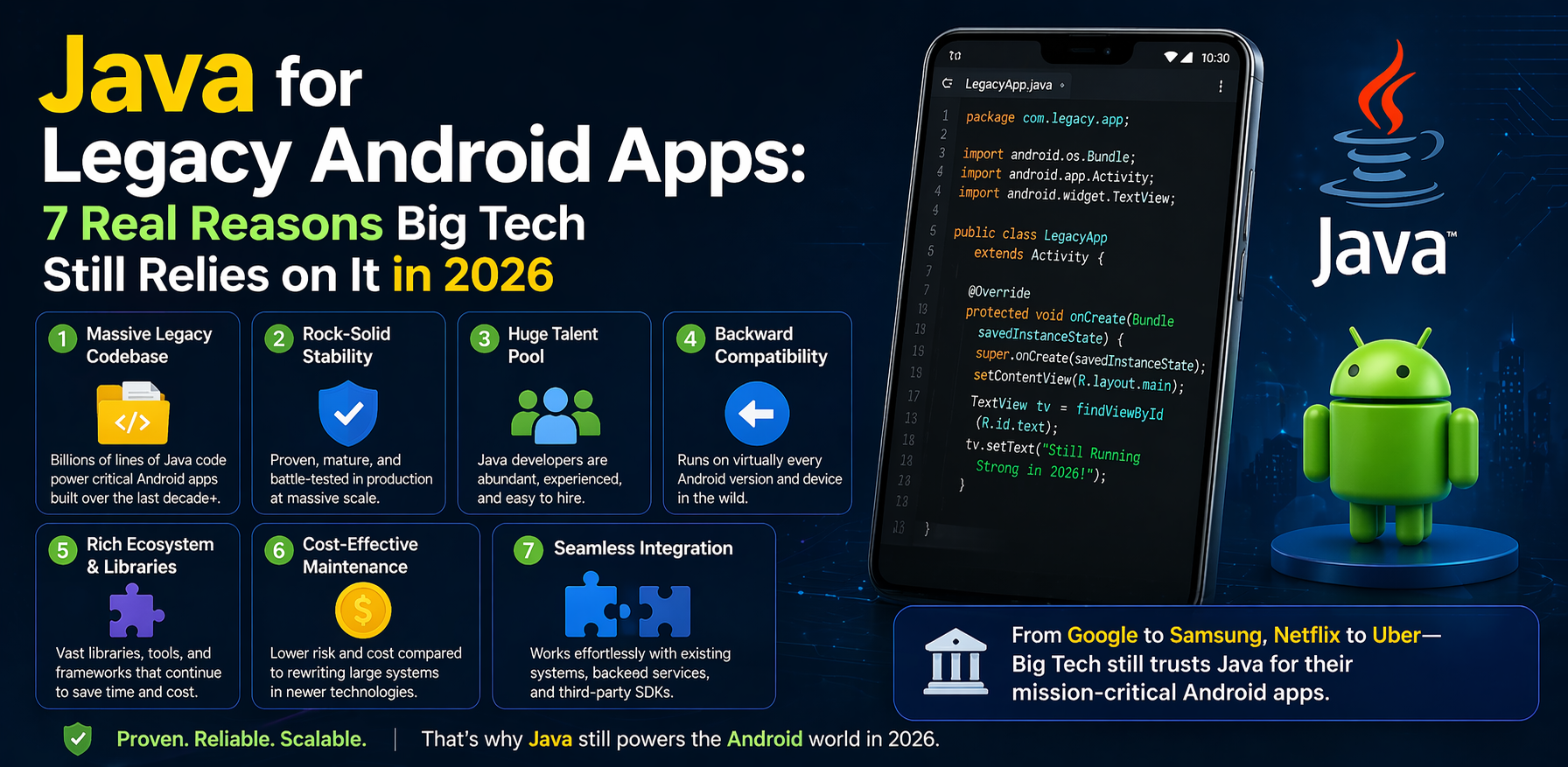
Many large, production-level Android apps — banking apps, social media apps, e-commerce platforms — still have massive Java codebases. Rewriting them fully in Kotlin takes time and carries risk. So companies keep large portions in Java while writing new features in Kotlin.
Some Android developers who’ve been in the field for 8-10 years still write Java. They know it deeply, and their employers aren’t forcing a change. Older Android projects maintained by small teams often stay in Java because migration isn’t worth the engineering effort.
But here’s the thing: if you’re starting fresh today, in 2026, building a new Android app from scratch — no professional Android developer or senior engineer will recommend you start with Java. That would be like learning to drive in a car with manual windows and no GPS when modern cars are readily available.
The Job Market Reality for Java Android Developers
Let’s talk numbers and practicality, because this is what actually matters for your career.
Job postings for Android development in 2025 and going into 2026 strongly favor Kotlin. A survey conducted by JetBrains (the company behind Kotlin) found that a significant majority of professional Android developers use Kotlin as their primary language. Java’s share in new Android projects continues to shrink year over year.
If you go on any major job platform and search “Android Developer,” you’ll notice that most job descriptions list Kotlin as a required or strongly preferred skill. Some still list Java as a nice-to-have — especially for roles that involve maintaining legacy code.
But for new Android developer roles, junior or otherwise, companies want Kotlin. They want developers who understand Coroutines, who can work with Compose, who are comfortable with modern Jetpack libraries. These are Kotlin-native concepts.
So while Java dying Android development doesn’t mean Java knowledge is worthless, it does mean that Java alone won’t get you very far in the current Android job market.
Should Beginners Still Learn Java Before Kotlin?
This is one of the most common questions I see from people just entering Android development.
Here’s my honest take: you don’t need Java to learn Kotlin or Android development. Kotlin is beginner-friendly. Google’s own “Android Basics with Compose” course on developer.android.com teaches complete beginners using Kotlin with zero Java requirement.
Some people argue that learning Java first gives you stronger programming fundamentals. There’s some truth to this — Java forces you to think about types, object-oriented principles, and structure in a very explicit way. But you can get all of those fundamentals from Kotlin too. Kotlin isn’t a “shortcut” language. It’s just more expressive and safer.
If you already know Java — from school, a bootcamp, or a previous job — that background will help you understand Kotlin faster. The mental models transfer. But if you’re starting from zero? Just go straight to Kotlin. Don’t take a detour through Java specifically for Android.
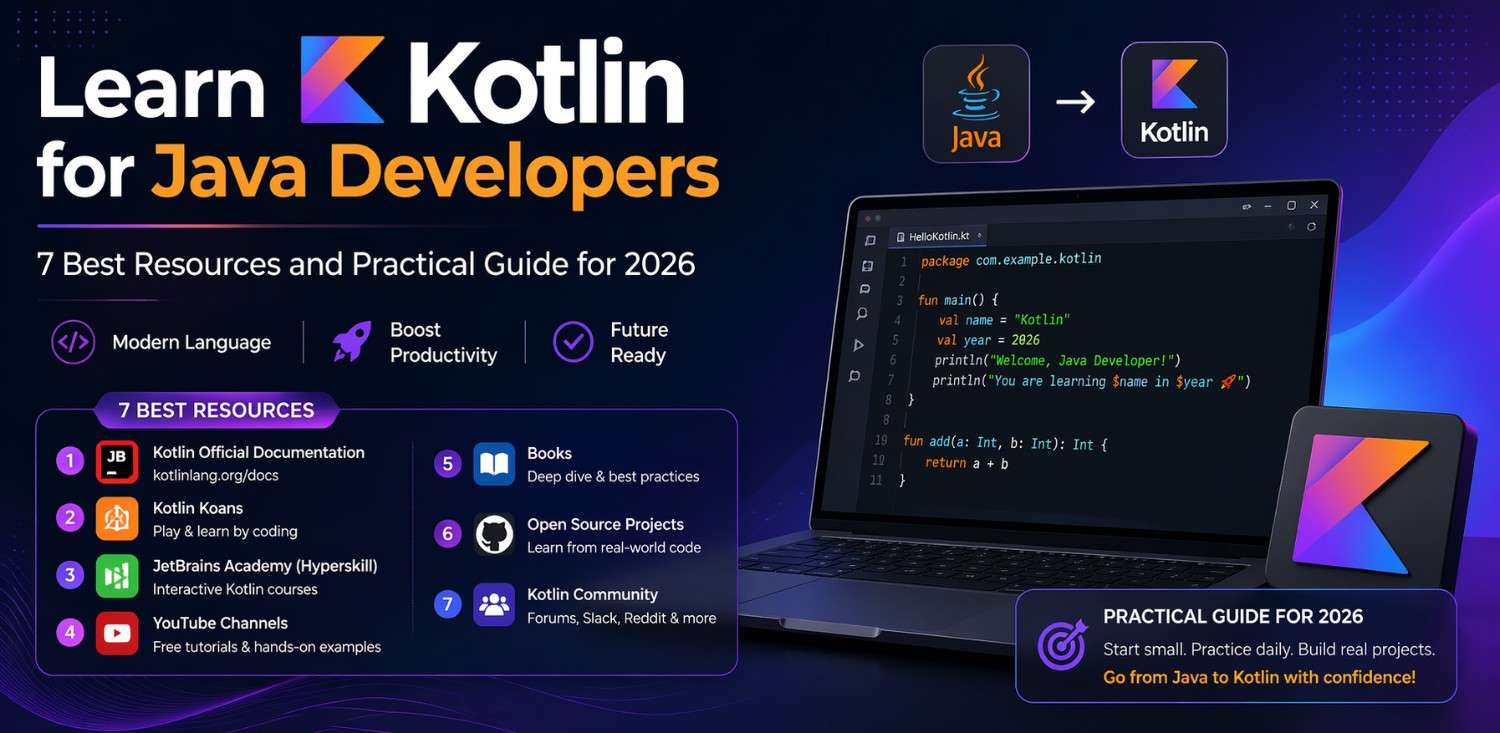
For a deeper understanding of Kotlin’s syntax differences, the official Kotlin documentation is genuinely well-written and beginner-accessible.
What About Existing Java Android Developers?
If you’re a working Android developer who writes Java professionally, should you panic?
Not exactly. But you should be aware of the direction things are moving.
The skills you’ve built — understanding Android lifecycles, working with activities and fragments, understanding threading, debugging with Logcat — all of that transfers directly. Kotlin isn’t a different platform. It’s a different language on the same platform.
Most senior Android developers I’ve spoken to recommend a gradual approach: start writing new files and features in Kotlin within your existing Java project. Android Studio makes interoperability easy. You’ll pick up Kotlin syntax fast if you already know Java, because the concepts are the same — the grammar is just different.
Resources like Android Developers’ official migration guide explain how to add Kotlin to an existing Java project step by step.
Java Dying Android Development – The Bigger Picture Beyond Android
It’s worth stepping back for a second. When we say Java dying Android development, we’re talking specifically about Java’s role in Android mobile apps. Not Java overall.
Java is still extremely alive in backend systems, enterprise software, Spring Boot web services, and big data pipelines. It’s one of the most used languages in the world across industries. Java developers in non-Android contexts are not in any sort of trouble.
But if your goal is specifically Android mobile app development in 2026, the reality is clear: Java’s role has been largely taken over by Kotlin, and the trajectory isn’t reversing.
Jetpack Compose and the Future Direction of Android
Jetpack Compose deserves its own mention here because it’s the clearest signal of where Android is heading.
Compose is Google’s modern, declarative UI framework for building Android interfaces. Instead of XML layouts, you write UI in pure Kotlin code. It’s faster to iterate, easier to test, and produces code that’s much more readable.
Google has been pushing Compose heavily since its stable release. Major apps — including Google’s own apps — have adopted it. New developer learning paths prioritize Compose. And since Compose is exclusively Kotlin, this further cements Java dying Android development as the industry’s de facto reality.
If you want to be a competitive Android developer in 2026, learning Compose is no longer optional. It’s foundational. And that means Kotlin is non-negotiable.
Common Misconceptions About Java and Android in 2026
Let me address a few things that often get misunderstood:
Misconception 1: “Java apps will stop working on Android soon.” This is not true. Android maintains backward compatibility. Apps written in Java years ago still run on modern Android devices.
Misconception 2: “Kotlin is harder than Java for beginners.” Most developers who’ve tried both say Kotlin is actually more beginner-friendly once you get past unfamiliar syntax. The null safety alone saves beginners from countless crashes.
Misconception 3: “Learning Java for Android will future-proof your skills.” It won’t — not for Android specifically. Java is a transferable skill for other domains, but for Android mobile development, Kotlin is where the future is.
Understanding these misconceptions is important for making clear-headed decisions about your learning path.
Final Conclusion
So here’s the honest summary: Java dying Android development is real, but it’s a gradual, practical shift — not a sudden collapse. Java isn’t broken, and existing Java Android code isn’t going anywhere immediately. But the momentum, the tooling, the documentation, the new frameworks, the job market, and Google’s own priorities have all moved firmly toward Kotlin.
If you’re a beginner, start with Kotlin. If you’re an existing Java Android developer, begin migrating at a comfortable pace. The fundamentals you know aren’t wasted — they transfer directly. But clinging to Java-only Android development in 2026 is choosing to work against the current rather than with it.
The goal of understanding this topic isn’t to cause anxiety. It’s to help you make smarter decisions about where to invest your learning time. And right now, in this real Android world, Kotlin is clearly the better investment.